

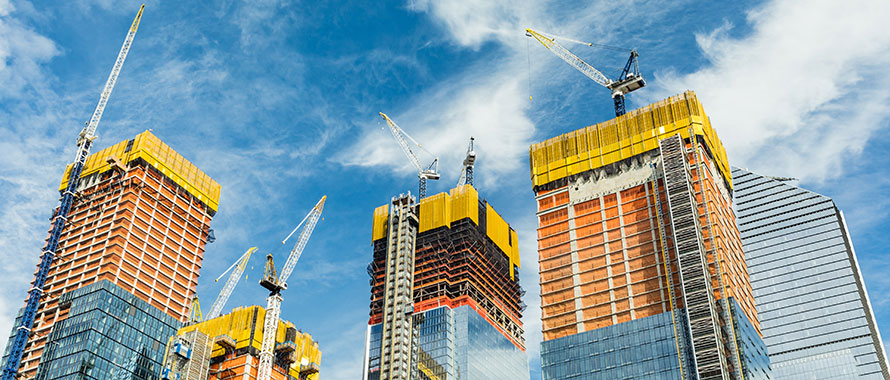
Work-related fatalities at New York City building construction sites reached their lowest point in almost 10 years in 2023, according to new data from the city, but work-related injuries jumped 25%, Safety+Health magazine reported on May 23.
Featured Solutions
Although data showed fewer fatalities, the rise in incidents and injuries is a concerning trend.
When injuries or deaths occur on the jobsite, companies generally rely on their Commercial General Liability (CGL) Insurance and Excess Liability Insurance to help pay for the expenses associated with claims and lawsuits, said Steven Hrab, Director, Construction, Burns & Wilcox, Toronto, Ontario. Due to the increased frequency of incidents, policy rates have also increased.
“The cost and the expenses incurred because of these losses are so high that they have to be offset by increased premium. We are seeing an increase in premium due to some of the frequency of losses,” he said. “Companies may attempt to underinsure themselves because the cost for insurance is so high.”
Cutting corners may increase injury risk
According to NYC’s recent building construction report, injuries in 2023 ranged from small cuts to “significant life-altering injuries resulting in prolonged hospitalization,” and the report noted that the split between fewer fatalities and more injuries underscored the complex task of working to foster a greater culture of safety in the industry. In 2022, construction was linked to the most fatalities of any industry in the U.S., Construction Dive reported in December of 2023.
In June of last year, Yahoo! Finance reported on the risk of homebuilders cutting corners in order to meet increased demand and expedite sales, and Arizona Public Radio reported last November on workers facing growing risks while working in increasingly hot temperatures and managing rising demand for work.

[Cutting corners] could be causing injuries on some of these build sites. I think that is a North American problem — not just a U.S. or Canadian issue.
“I think a lot of the incidents we see trend into more serious injuries or fatalities because a lot of the trades and contractors are not necessarily enforcing the guidelines set out by either the cities or the insurance companies,” Hrab said. “In a bid to get business or to get the work done and completed in a speedy manner because interest rates are very high, they want to get it done sooner, and as a result I think they may be cutting corners. This could be causing injuries on some of these build sites. I think that is a North American problem — not just a U.S. or Canadian issue.”
Construction companies purchasing CGL Insurance may encounter a variety of restrictions on their coverage, including residential exclusions, height exclusions, direct payroll exclusions, and more. More and more carriers have decided to pull out of the marketplace or are adding a bodily injury exclusion to their policies, which would not cover an employee. It is important to make sure that these policies include injury-to-employee coverage.
The distinctions make it critical that construction company owners work with a knowledgeable insurance broker when seeking coverage — especially for the unique risk of construction in New York City. “There are so many things to look out for. The best brokers in the world simply focus on New York construction — it is a niche industry and you have to be an expert on it,” he said. “You cannot be a generalist; you either know it, or you do not. It takes years and years to really learn the market and the laws regarding New York.”
Insurance more difficult to obtain amid increasing incidents
Building construction in New York City and other urban areas comes with unique risks. In 2022, the death rate for construction workers in New York City was 11.5 per 100,000, an increase from 11.2 per 100,000 in 2021, the nonprofit news outlet The City reported in February. Short staffing for regulators could play a role; according to the publication, OSHA conducted 29% fewer inspections in 2022 compared to 2019.
In January, five individuals were injured when a boom truck collapsed at a New York City construction site, CBS News reported, and a crane collapse at a New York City construction site last July caused 12 individuals, including construction workers, to be hospitalized, according to CNN. In Toronto, several workers were hospitalized after a construction accident last July possibly related to machinery ventilation, CTV News reported.
High foot traffic in places like New York City increases construction site risks. Pedestrian slips and falls on sidewalks or construction equipment falling are common exposures. However, injury-to-employee claims tend to cost the most. Often, these claims are full-limit losses of $1 million to $2 million. In many cases, Excess Liability Insurance is also needed and could require working with multiple carriers to obtain higher limits.
Lack of insurance could bankrupt company
According to OSHA, several of the most frequently-cited standards across all industries are found in the construction industry, including fall protection, ladders, scaffolding, and fall protection training. The recent construction incident report from New York City underscores the importance of risk management at construction sites, Hrab said.
“With increased injuries, there is always going to be the potential for an increase in fatalities,” he said. “If corners are cut or safety guidelines are not necessarily met, then unfortunately the exposure of a fatality or a heinous injury is going to be much greater. It is the law of large numbers. If you are not monitoring liability issues, the chance of a fatality is going to be much higher.”
This includes being aware of local, state and federal guidelines for projects, adhering to safety standards and hiring experienced, well-trained workers. “Ensuring you have the right workers on a build site is obviously very important to minimize losses,” Hrab said, adding that an on-site safety supervisor may also be beneficial. “That can help minimize injury losses. The cost of bringing someone on outweighs the cost of the company potentially being on the hook to pay out a loss.”
Construction companies should also review their insurance coverages regularly. Without the right policy in place at the time of a loss, “it absolutely could wipe out a company,” Hrab said. “Especially in the U.S., where there is very little threshold for lawsuits, it could basically bankrupt a company, depending on the size of the company. It could effectively wipe them out.”