

Inside This Article:
- A Halloween lawn decoration depicting a skeleton riding a rooster was recently stolen from a homeowner’s yard in Henderson, Kentucky.
- Beyond the risk of theft, seasonal decorations can also pose fire hazards, with home fires involving decorations causing about $17 million per year in property damage between 2019 and 2023.
- Homeowners Insurance can cover theft, fire damage, and liability claims related to Halloween activities, while Personal Umbrella Insurance can be purchased for additional liability protection.
- Homeowners can help reduce Halloween risks by keeping walkways clear, checking electrical decorations, and securing pets.
Police are looking for a Halloween display featuring a skeleton riding a chicken, modeled after a popular Minecraft meme, that recently disappeared from a homeowner’s yard in Henderson, Kentucky, according to WFIE 14 News.
The Henderson Police Department took a playful approach to the search by referencing the “chicken jockey” scene from A Minecraft Movie and reminding residents that stealing decorations is “a crime, not a video game quest.” Police urged whoever took the sculpture to return it “to their rightful roost,” the news outlet reported.
“You could tell that the police found it a bit funny,” said Alison Sanelli, Senior Underwriter, Personal Insurance, Burns & Wilcox, Toronto, Ontario. Despite the humorous response, “we do see some pretty expensive Halloween decorations, and theft is an insured peril,” she said.
Halloween decorations can also lead to other potential risks, including vandalism, fires, or liability concerns. Homeowners Insurance can often respond in these situations, though smaller theft losses may fall below the policy deductible, said Chanon Murphy, Senior Underwriter, Personal Insurance, Burns & Wilcox, Houston, Texas.
“There are multiple things to consider when talking about Halloween decorations — fire hazards, the potential property damage, and then third-party injuries,” she said. “If you just have one little sculpture out there, I think you are probably OK, but in these subdivisions where they really go all-out, you have to worry about trip-and-fall hazards and liability issues.”
There are multiple things to consider when talking about Halloween decorations — fire hazards, the potential property damage, and then third-party injuries.
When decorations disappear
Although police did not identify the value of the lawn display in the recent “chicken jockey” theft, many homeowners today are purchasing elaborate decorations, including 8- to 12-foot skeletons — some of which remain on display year-round, the Los Angeles Times reported in July. Large-scale displays can be costly, Sanelli said.
In Livonia, Michigan, a homeowner’s Halloween display was recently vandalized and left with over $1,600 in damage, including destroyed animatronic decorations, WXYZ reported Oct. 12. While the Insurance Information Institute reports that theft claims overall averaged $5,524 between 2019 and 2023, seasonal decor losses may not justify a claim, Murphy said.
On a Homeowners Insurance policy, “all of your decorations are typically going to be considered personal property,” she said. “Would the theft be covered? Most likely, yes, but you have to think about the cost.”
For example, a policy with $500,000 in dwelling coverage and a 1% deductible would leave the homeowner responsible for the first $5,000 of a covered property loss, Murphy explained. “Those items are going to be under your deductible most of the time,” she said. “You may not want to file a claim on a single item and have it affect your future insurance premiums.”
Vandalism incidents around Halloween could also lead to Homeowners Insurance claims, Sanelli said. “It is a mischievous night, and so mischievous individuals could be out and about looking for trouble,” she said. “There is typically coverage for vandalism and malicious acts, and the homeowner should decide whether or not it is worthwhile to put in a claim.”
It is a mischievous night, and so mischievous individuals could be out and about looking for trouble. There is typically coverage [on Homeowners Insurance] for vandalism and malicious acts.
Before reporting a smaller loss, homeowners should consult with their insurance broker, she advised. “Do not make a knee-jerk reaction,” Sanelli said. “Have a thoughtful conversation with your broker first.”
Keep fire hazards out of festivities
An average of 832 home structure fires were started by decorations each year between 2019 and 2023, causing $17 million in annual direct property damage, according to the National Fire Protection Association. In about 47% of these fires, decorations were placed too close to a heat source, while one-third were started by candles.
Homeowners may recognize the danger of jack-o’-lantern candles but overlook risks like combustible crafts or exposed wiring, Sanelli said. “I do not think most homeowners think too much about where decorations are placed or how old they are,” she said. “There is a mix, but it is often a very narrow understanding of fire safety when it comes to decorations.”
I do not think most homeowners think too much about where decorations are placed or how old they are.
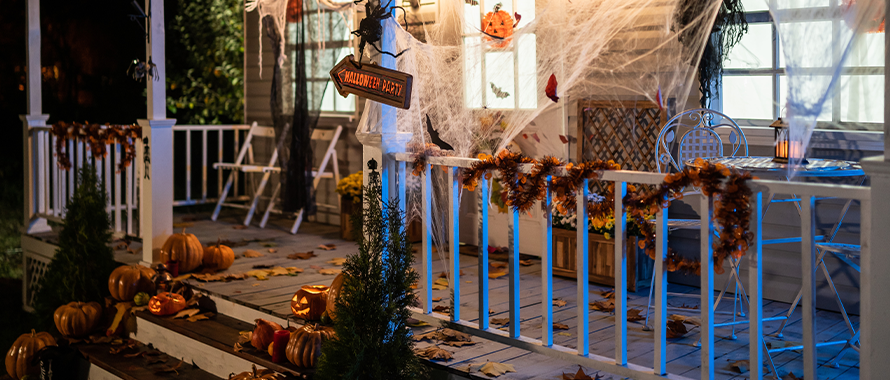
In addition to carrying Homeowners Insurance, property owners should check seasonal decorations for damaged cords before installation and keep flammable materials away from furnaces and other appliances.
“October 31 is usually around the time when we typically transition into cooler weather [in Canada], so individuals are turning on their heat or maybe their wood stoves,” Sanelli said. “If there are flammable decorations surrounding those appliances, there could be a higher potential for a fire loss.”
Other safety tips include using battery-operated candles, securing outdoor displays against wind, and ensuring electrical decorations are rated for their intended location, Murphy said.
“There are some really cool decorations that look great, but they might not be rated for outside use,” she said, adding that homeowners should be careful about how decor is installed. “Never put nails, screws, or fasteners in your roof. It can affect the water barrier.”
Making space for safe trick-or-treating
Dog-related injury claims cost U.S. insurers $1.86 billion in 2025, with an average cost of $65,450 per claim, according to the Insurance Information Institute. On Halloween, trick-or-treating crowds could mean a higher risk of dog bites, Murphy said.
“There is more noise, more flashing lights, more strangers,” she said, encouraging homeowners to secure pets during the festivities. “If your dog is aggressive or scared, it may not be the best idea to have them walking around the children. Even the most docile, calm dog could get frightened and scared with the trick-or-treating activity.”
Even the most docile, calm dog could get frightened and scared with the trick-or-treating activity.
Decorations should leave room for visitors to approach the home safely, Murphy added. “Are individuals going to be walking through your yard? Could they trip over an extension cord or fall over because your lighting is not sufficient?”
Porch steps, missing railings, and crowded entrances could also create injury risks, Sanelli said.
“As a parent myself, watching kids almost bulldoze over the little ones to get to the door first is a hazard,” she said. “Sometimes we are dealing with very young children, so the chance of a slip-and-fall is much greater.”
Personal Liability Coverage under a Homeowners Insurance policy can respond to third-party injuries that occur on a homeowner’s property, and Personal Umbrella Insurance can provide additional protection above underlying liability limits, Murphy said. Homeowners who host paid haunted attractions should discuss those plans with an insurance professional, as charging admission could introduce coverage restrictions, she said. Annual policy reviews can identify other changes affecting coverage.
“Did you renovate or remodel? Did you install a pool or a new playground?” she said. “Even if you think it is minor, it is worth reviewing to make sure that you are adequately covered.”